
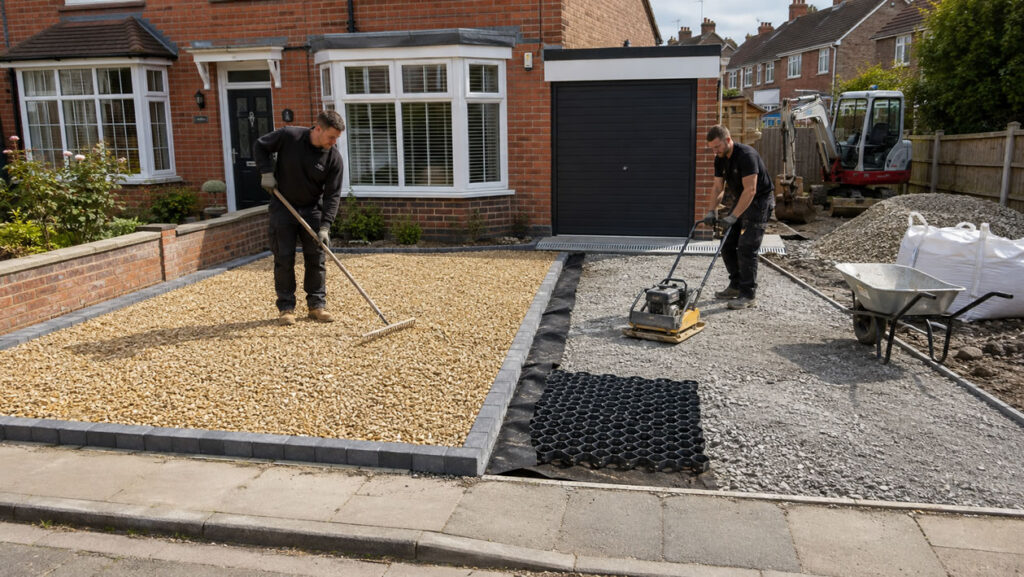
It works particularly well for larger driveways, rural properties and homeowners who want a more traditional appearance than tarmac or concrete. Gravel also drains naturally and can be topped up relatively easily when the surface starts to look thin.
However, a good gravel driveway involves much more than spreading decorative stone over the ground.
The quality of the excavation, sub-base, membrane and edging makes a major difference to how well the driveway performs. Without proper preparation, gravel can develop ruts, potholes, weeds and muddy patches surprisingly quickly.
As a broad 2026 UK guide, a professionally installed gravel driveway typically costs around £40 to £70 per m², although more complex projects and premium decorative aggregates can push the price higher.
A typical 40 to 50m² two-car driveway might therefore cost around £1,800 to £3,500.
This guide explains gravel driveway prices, installation methods, gravel types, maintenance and what homeowners should compare when requesting driveway quotes.
How much does a gravel driveway cost?
Typical UK guide prices are:
| Gravel Driveway | Typical Cost |
|---|---|
| Professionally installed gravel driveway | £40–£70 per m² |
| Higher-spec gravel driveway | £70–£90+ per m² |
| Small 20m² driveway | £900–£1,500 |
| Medium 40–50m² driveway | £1,800–£3,500 |
| Large 80m² driveway | £3,200–£6,000+ |
| Gravel top-up only | £8–£20+ per m² |
| Gravel grid system | Additional £10–£30+ per m² |
The condition of the existing ground has a major influence on the final quote.
A driveway installed over lawn or soil needs much more preparation than an existing gravel drive that only needs topping up.
Typical gravel driveway costs by size
| Driveway Size | Typical Use | Broad Installed Cost |
| 15–20m² | Small single-car drive | £800–£1,500 |
| 25–35m² | Large single-car drive | £1,200–£2,400 |
| 40–50m² | Two-car drive | £1,800–£3,500 |
| 60–80m² | Large two or three-car drive | £2,800–£6,000 |
| 100m² | Large frontage | £4,000–£7,000+ |
Premium decorative gravel, retaining walls or difficult access can push these figures higher.
Why is gravel cheaper than other driveway surfaces?
Gravel is relatively inexpensive because the finished surface is simple to install compared with materials such as:
- block paving
- resin
- concrete
- natural stone
There is no need to lay thousands of individual paving blocks or spread hot asphalt.
The surface gravel itself is also relatively inexpensive.
However, the groundwork underneath still needs to be done properly.
That is where much of the cost goes.
What does gravel driveway installation involve?
A typical installation includes several stages.
1. Marking out the driveway
The contractor establishes the shape, levels and boundaries.
This is also the point where they plan:
- access
- drainage
- edging
- turning areas
2. Excavating the ground
Existing:
- grass
- soil
- old paving
- weak gravel
may need to be removed.
For a completely new driveway, excavation may reach around 150 to 200mm depending on the ground conditions and proposed specification.
3. Removing waste
Excavated material needs to be taken away.
The contractor may use:
- skips
- grab lorries
- tipper trucks
Waste removal can make a noticeable difference to the total quote.
4. Installing the sub-base
A strong compacted base is essential.
MOT Type 1 or another suitable granular material is commonly used.
The contractor lays and mechanically compacts it to create a stable foundation.
5. Installing a membrane
A geotextile membrane can help stop the sub-base mixing with the soil underneath.
Depending on the system, it can also help control weed growth.
6. Installing edging
Gravel needs strong boundaries.
Without edging, stones gradually spread onto:
- lawns
- paths
- pavements
- flower beds
7. Laying the gravel
The decorative aggregate is spread evenly across the prepared surface.
8. Final levelling
The contractor rakes the driveway to create an even finish.
The sub-base is the most important part
The decorative gravel may be the only part you see, but the foundation underneath determines how the driveway performs.
A poor sub-base can cause:
- wheel ruts
- potholes
- sinking
- muddy patches
- uneven surfaces
A good contractor should be able to explain:
- excavation depth
- sub-base material
- sub-base depth
- compaction method
Be cautious of very cheap quotes that simply propose spreading new gravel over soil.
How deep should a gravel driveway be?
The complete construction may be around 150 to 200mm or more depending on the site.
This can include:
- compacted sub-base
- gravel surface layer
The decorative gravel layer itself is often around 40 to 50mm.
Too much loose gravel can actually make driving more difficult because tyres sink into the stones.
A relatively shallow surface layer over a strong base usually works better.
What gravel is best for a driveway?
Driveway gravel should be:
- angular
- durable
- large enough not to become easily displaced
- suitable for vehicle traffic
A common size is around 14 to 20mm.
Angular gravel locks together better than very rounded stones.
Rounded pebbles tend to roll under tyres and move more easily.
Popular gravel colours
Homeowners can choose from a wide variety of aggregates.
Popular options include:
- golden gravel
- Cotswold buff
- grey granite
- limestone
- flint
- red granite
- black basalt
- mixed decorative stone
The best colour often depends on:
- brick colour
- render
- roof colour
- surrounding landscaping
Golden gravel driveways
Golden gravel is particularly popular on traditional UK homes.
It works well with:
- red brick
- stone houses
- cottages
- cream render
It creates a warmer appearance than grey aggregate.
Grey gravel driveways
Grey aggregates provide a more contemporary look.
They often work well with:
- modern extensions
- grey windows
- rendered properties
- black or anthracite details
Granite and limestone are common choices.
How much does driveway gravel cost?
The decorative gravel itself might cost around £8 to £20 per m² depending on:
- stone type
- colour
- size
- depth
- delivery
Premium decorative aggregates cost more.
However, the finished driveway cost is much higher because it also includes:
- excavation
- sub-base
- membrane
- edging
- labour
How much gravel do I need?
The amount depends on:
- area
- required depth
- stone density
For a 50m² driveway with approximately 50mm of surface gravel, several tonnes of aggregate may be required.
Suppliers often provide online volume calculators, but your installer should calculate the quantity as part of the quotation.
Gravel driveway grids
Gravel grids are plastic or recycled-plastic cellular systems laid beneath the decorative aggregate.
The cells hold gravel in place.
They can help reduce:
- rutting
- migration
- wheel tracks
- loose stones spreading
Grid systems are particularly useful for:
- regularly used driveways
- parking bays
- turning areas
How much do gravel grids cost?
Adding a grid system may cost around £10 to £30 or more per m², depending on the product.
This increases the initial installation cost.
However, it can reduce maintenance and help the driveway remain more stable.
Are gravel grids worth it?
Often, yes.
They can be particularly useful where:
- cars turn frequently
- the driveway slopes slightly
- wheelchair or pushchair access matters
- gravel movement is a concern
The system still needs a proper sub-base underneath.
A grid should not be used to compensate for poor groundwork.
Gravel driveway edging
Edging is essential.
Popular options include:
- concrete kerbs
- brick
- block paving
- stone setts
- metal edging
- timber
Decorative borders can significantly improve the appearance of an otherwise simple gravel driveway.
Block paving borders
Block edging is particularly popular.
It creates a clean boundary around:
- driveway edges
- paths
- lawns
- flower beds
It can also be used to mark individual parking bays.
Gravel driveway drainage
One of gravel’s biggest advantages is that it is naturally permeable.
Rainwater can usually soak through the surface rather than running directly into drains.
However, the complete driveway design still needs to consider:
- soil drainage
- sub-base permeability
- ground levels
- nearby buildings
Poorly designed gravel driveways can still develop puddles if the ground underneath is compacted or poorly drained.
Do gravel driveways need planning permission?
A major advantage of gravel is that it is normally considered a permeable surface.
Therefore, many domestic front garden gravel driveways can be installed without planning permission, provided water drains appropriately within the property.
However, other restrictions can still apply.
These might involve:
- listed buildings
- conservation areas
- boundary walls
- trees
- major level changes
You may also need permission for a dropped kerb.
Dropped kerbs and gravel driveways
If vehicles need to cross a public pavement to reach your new driveway, you normally need an approved vehicle crossover.
This applies regardless of whether the driveway uses:
- gravel
- tarmac
- resin
- paving
The local highway authority controls the dropped kerb process.
A driveway contractor may be able to advise you, but do not assume that installing gravel gives permission to drive across the pavement.
Can you turn a front garden into a gravel driveway?
Often, yes.
Gravel is particularly suitable for front garden conversions because it:
- drains naturally
- costs less than most hard paving
- installs relatively quickly
- can retain a softer garden appearance
You can also combine gravel with:
- planted borders
- hedges
- trees
- block-paved paths
This can create parking without making the whole frontage look heavily paved.
Gravel driveway top-up costs
Existing gravel driveways do not always need complete replacement.
If the base remains strong, the driveway may only need:
- levelling
- weed removal
- pothole repair
- additional gravel
A simple top-up may cost around £8 to £20 per m² for aggregate, plus labour and delivery.
This is much cheaper than rebuilding the whole driveway.
When does an old gravel driveway need full replacement?
Full reconstruction may make sense when:
- deep potholes keep returning
- the driveway becomes muddy
- there is very little sub-base
- large areas sink
- drainage is poor
- gravel mixes into the soil
- weeds are severe
Repeatedly adding more gravel will not fix a failing foundation.
Gravel driveway potholes
Potholes usually form because vehicle tyres repeatedly displace material.
Water can then collect in the depression and make it worse.
A proper repair may involve:
- removing loose gravel
- digging out weak material
- replacing sub-base
- compacting it
- restoring the gravel surface
Simply filling the dip with loose gravel may provide only a temporary improvement.
Do gravel driveways get weeds?
Yes, but not always for the reason people expect.
A membrane can help stop weeds coming up from the soil.
However, over time:
- dust
- soil
- leaves
- organic matter
can collect between the stones.
Weed seeds can then grow in this material from above.
Routine maintenance still matters.
How to reduce weeds
You can reduce weeds by:
- installing a suitable membrane
- keeping the driveway clean
- removing weeds early
- raking the gravel
- keeping nearby borders tidy
Occasional treatment may also be appropriate.
Gravel driveway maintenance
Gravel needs more regular maintenance than tarmac or resin.
Typical jobs include:
- raking
- topping up low areas
- removing weeds
- redistributing stones
- repairing potholes
- clearing leaves
Fortunately, most of this work is straightforward.
How often does gravel need topping up?
Many driveways benefit from additional gravel every 2 to 5 years.
Frequency depends on:
- vehicle use
- edging
- gravel depth
- slope
- grid system
- stone type
A well-built driveway with strong edging may need less frequent topping up.
Gravel migration
Loose gravel naturally moves under vehicle tyres.
It often collects:
- near entrances
- at turning points
- beside parking spaces
Strong edging and gravel grids reduce this problem.
Is gravel suitable for sloping driveways?
Only up to a point.
Loose gravel can move downhill over time.
Steeper slopes can therefore become difficult to maintain.
For a pronounced slope, alternatives such as:
- block paving
- asphalt
- resin
may perform better.
A grid system can help on gentle gradients.
Gravel and wheelchair access
Loose gravel is not ideal for:
- wheelchairs
- walking frames
- pushchairs
- small-wheeled bins
A stabilisation grid improves the surface but does not make it identical to solid paving.
Some homeowners combine gravel parking with a smooth paved path from the pavement to the front door.
Is gravel noisy?
Yes, and some homeowners see this as an advantage.
Footsteps and vehicles make noticeable noise on gravel.
This can provide a small security benefit because approaching visitors are easier to hear.
Does gravel damage cars?
Correctly sized driveway gravel should not normally cause problems.
However, very small loose stones can:
- stick in tyre tread
- scatter under fast-moving wheels
Using appropriate 14–20mm angular driveway gravel reduces this issue.
Gravel driveway lifespan
A properly constructed gravel driveway can last for decades.
Unlike asphalt or concrete, the surface itself does not need complete replacement at a fixed age.
Instead, homeowners can:
- repair the sub-base locally
- rake the surface
- add fresh gravel
The underlying foundation determines long-term performance.
Gravel vs tarmac driveway
| Feature | Gravel | Tarmac |
| Typical cost | £40–£70/m² | £60–£90+ per m² |
| Drainage | Excellent | Needs drainage design |
| Maintenance | Moderate | Low |
| Installation | Quick | Quick |
| Appearance | Traditional | Simple |
| Weed potential | Moderate | Low |
| Stone movement | Yes | No |
| Repairs | Easy | Moderate |
Gravel normally costs less.
Tarmac provides a smoother and lower-maintenance surface.
Gravel vs block paving
Block paving usually costs considerably more.
Choose gravel when:
- budget matters
- the driveway is large
- natural drainage matters
- you prefer a traditional look
Choose block paving when:
- decorative design matters
- you want a solid surface
- lower routine maintenance matters
- pushchair or wheelchair access matters
Gravel vs resin-bound driveway
These two surfaces can look superficially similar because both use decorative aggregate.
However, they are very different.
Loose gravel
Individual stones remain loose.
Resin bound
Stone is mixed with resin and trowelled into a solid surface.
Resin costs considerably more but provides:
- no loose stone movement
- easier walking
- cleaner appearance
- lower maintenance
Loose gravel remains the cheaper option.
Gravel vs concrete
Concrete creates a solid surface and needs less maintenance.
However, gravel normally costs less and provides much better natural drainage.
Concrete can also crack over time, whereas gravel can simply be redistributed or topped up.
Is gravel a good choice for large driveways?
Yes.
This is one of gravel’s strongest uses.
Large areas can become expensive in:
- block paving
- resin
- natural stone
Gravel keeps the surface cost relatively low.
This makes it popular for:
- country homes
- long driveways
- large detached properties
- multiple parking areas
How long does installation take?
A typical domestic gravel driveway may take around 2 to 5 working days.
| Project | Typical Time |
| Simple gravel top-up | 1 day |
| Small new driveway | 2–3 days |
| Two-car driveway | 3–5 days |
| Large driveway | 4–7+ days |
Most of the time is spent preparing the foundation rather than spreading the gravel.
Can I install a gravel driveway myself?
Gravel itself is relatively easy to spread.
However, a complete driveway involves:
- excavation
- heavy aggregate
- compaction
- levels
- drainage
The project may require:
- mini digger
- vibrating plate
- skips
- bulk deliveries
DIY can work for small areas, but professional installation usually makes sense for a full vehicle driveway.
What affects gravel driveway quotes?
Driveway size
Larger driveways need more material.
Existing surface
Removing concrete costs more than excavating lawn.
Excavation depth
Poor ground may need deeper excavation.
Sub-base
A stronger or deeper base increases upfront cost.
Gravel type
Premium decorative aggregates cost more.
Edging
Stone or block paving borders increase the price.
Gravel grids
Stabilisation systems add material and labour.
Access
Narrow sites can make excavation and delivery harder.
Waste disposal
Removing soil and old surfacing adds cost.
Drainage
Additional drainage can increase the quote.
What should a gravel driveway quote include?
Check whether each contractor includes:
| Quote Item | What to Check |
| Excavation | Depth included |
| Waste removal | Included? |
| Sub-base | Type and depth |
| Compaction | Included? |
| Membrane | Included? |
| Gravel | Type, colour and size |
| Gravel depth | Confirmed? |
| Edging | Included? |
| Grids | Included or optional? |
| Drainage | How is water handled? |
| Manholes | Adjustments included? |
| Labour | Fully included? |
| VAT | Included or extra? |
A detailed quotation makes it easier to compare installers fairly.
Cheap gravel driveway quotes
A very cheap quote may exclude:
- deep excavation
- sufficient sub-base
- proper compaction
- strong edging
- membrane
- waste removal
The finished surface may look good initially.
However, problems can develop after repeated vehicle use.
The groundwork should always be the first thing you compare.
Common gravel driveway mistakes
Too little sub-base
This causes rutting and sinking.
Too much surface gravel
Tyres sink and stones move excessively.
Rounded gravel
Rounded stones move more easily than angular aggregate.
Weak edging
Gravel spreads into neighbouring areas.
Poor compaction
The driveway develops dips.
Ignoring drainage
Water creates soft areas and potholes.
Questions to ask a gravel driveway installer
Before choosing a contractor, ask:
- How deep will you excavate?
- What sub-base will you use?
- How thick will it be?
- Will it be mechanically compacted?
- Is a membrane included?
- What gravel size do you recommend?
- How deep will the gravel layer be?
- Should I use gravel grids?
- What edging is included?
- How will water drain?
- Is waste disposal included?
- How long will the work take?
- What guarantee do you provide?
Get gravel driveway quotes
A gravel driveway is one of the most affordable ways to create a practical parking area.
Typical professionally installed costs currently sit around £40 to £70 per m², while a standard two-car driveway may cost approximately £1,800 to £3,500 depending on groundwork and specification.
The visible gravel is relatively inexpensive. The real value comes from proper excavation, a strong compacted sub-base and good edging.
Use the quotation form on this page to compare gravel driveway quotes from local driveway and landscaping specialists.
Frequently Asked Questions
How much does a gravel driveway cost in the UK?
A professionally installed gravel driveway typically costs around £40 to £70 per m², although premium stone and complicated groundwork can cost more.
How much does a 50m² gravel driveway cost?
A typical 40–50m² two-car gravel driveway may cost around £1,800 to £3,500 depending on excavation, sub-base, gravel and edging.
Is gravel the cheapest driveway option?
Usually, yes. Gravel is generally cheaper than tarmac, concrete, block paving and resin-bound surfacing.
What size gravel is best for a driveway?
Angular gravel around 14 to 20mm is commonly used because it locks together better and moves less than very small or rounded stone.
Does a gravel driveway need a sub-base?
Yes. A compacted sub-base helps prevent potholes, rutting and muddy areas.
Does a gravel driveway need a membrane?
A suitable geotextile membrane can help separate the ground from the sub-base and may also assist with weed control.
Are gravel driveway grids worth using?
They can be worthwhile where gravel movement, wheel tracks or accessibility are concerns.
How often does driveway gravel need topping up?
Many gravel driveways need topping up approximately every two to five years, depending on use and construction.
Do weeds grow through gravel driveways?
They can. Some weeds grow from seeds that settle in dust and organic material above the membrane rather than coming directly through from the soil.
Is gravel suitable for a sloping driveway?
It can work on gentle slopes, particularly with stabilisation grids, but loose gravel may migrate on steeper driveways.
Do gravel driveways need planning permission?
Gravel is normally a permeable surface, so many ordinary domestic driveways can be installed without planning permission. Other restrictions or dropped kerb requirements may still apply.
Should I compare several gravel driveway quotes?
Yes. Compare excavation depth, sub-base specification, membrane, gravel type, edging and waste removal as well as the final price.