
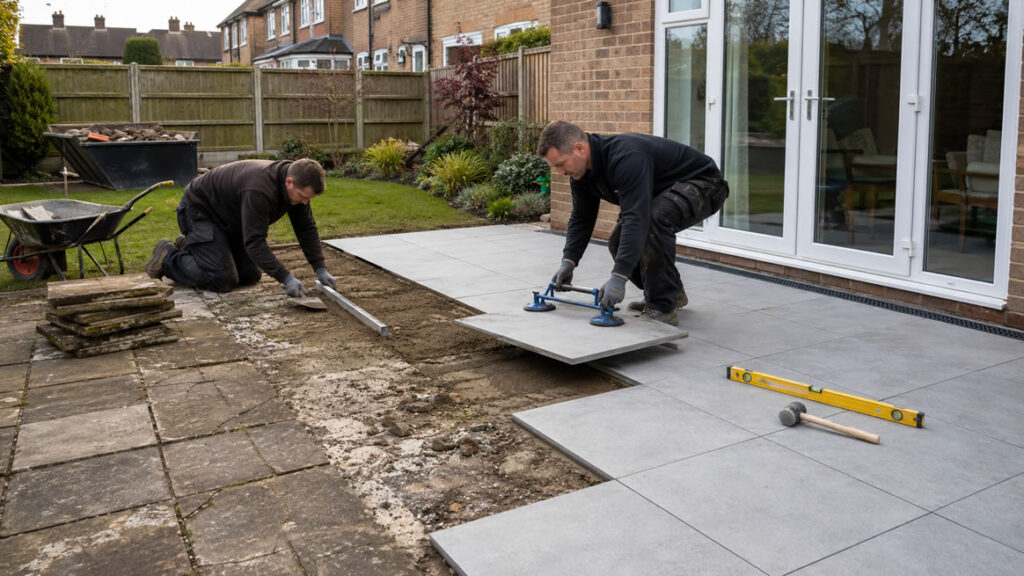
Over time, paving can crack, sink, become stained, develop loose joints or simply look dated compared with the rest of the garden. In some cases, replacing one or two slabs is enough. In others, the better option is to lift the entire patio, rebuild the base and install a completely new surface.
As a broad 2026 UK guide, replacing a patio can cost around £120 to £250 per m², depending on the paving material, condition of the existing base and amount of preparation needed.
A typical 20m² replacement patio might therefore cost around:
- £2,400 to £3,200 using concrete slabs
- £3,000 to £4,400 using sandstone or limestone
- £3,600 to £5,000 using porcelain paving
Premium stone, awkward access, drainage changes and retaining walls can push the project considerably higher.
This guide explains when patio slabs can be replaced individually, when the whole patio should be relaid, typical replacement costs and which new paving materials are worth considering.
When should patio slabs be replaced?
Patio slabs may need replacing when they are:
- cracked
- rocking
- badly stained
- frost damaged
- sinking
- uneven
- heavily chipped
- becoming slippery
- no longer matching the garden
Sometimes the slab itself is the problem.
However, uneven paving often points to a failure underneath.
Possible causes include:
- poor sub-base preparation
- weak mortar
- water washing material away
- tree roots
- ground movement
- badly compacted soil
If several slabs have moved, simply replacing the visible paving may not solve the problem.
Can you replace individual patio slabs?
Yes.
Replacing one or two slabs can make sense when:
- the rest of the patio remains level
- only a few slabs are cracked
- the bedding underneath remains sound
- matching paving is available
The contractor carefully lifts the damaged slab, removes loose bedding material and installs a replacement on a suitable mortar bed.
This is normally much cheaper than relaying the entire patio.
How much does it cost to replace one patio slab?
A small repair may cost around £100 to £250, depending on:
- access
- slab type
- whether a matching replacement is available
- size and weight of the slab
- whether the base needs repair
Very small jobs can seem expensive compared with the cost of the paving itself because the contractor still has travel and setup time.
When should the whole patio be replaced?
Full replacement usually makes more sense when:
- many slabs move underfoot
- large areas have sunk
- water regularly pools
- pointing keeps cracking
- the patio sits too high against the house
- the base was badly constructed
- the paving is badly weathered
- you want a completely different style
If several problems keep returning, replacing individual slabs can become false economy.
Typical patio slab replacement costs
Current UK guide prices are:
| Replacement Material | Typical Installed Replacement Cost |
|---|---|
| Concrete slabs | £120–£160 per m² |
| Indian sandstone | £150–£220 per m² |
| Limestone | £150–£220+ per m² |
| Porcelain | £180–£250 per m² |
| Premium natural stone | £200–£300+ per m² |
These figures typically include:
- lifting the old patio
- disposal
- standard groundwork
- new paving
- labour
- jointing
Major drainage or structural work usually costs extra.
Patio replacement costs by size
| Patio Size | Concrete | Sandstone / Limestone | Porcelain |
| 10m² | £1,200–£1,600 | £1,500–£2,200 | £1,800–£2,500 |
| 15m² | £1,800–£2,400 | £2,250–£3,300 | £2,700–£3,750 |
| 20m² | £2,400–£3,200 | £3,000–£4,400 | £3,600–£5,000 |
| 25m² | £3,000–£4,000 | £3,750–£5,500 | £4,500–£6,250 |
| 30m² | £3,600–£4,800 | £4,500–£6,600 | £5,400–£7,500 |
Complex layouts can cost more.
Why patio replacement costs more than new installation
Replacing an existing patio creates extra work.
Before the installer can start laying new slabs, they may need to:
- break out old mortar
- lift heavy paving
- remove rubble
- load skips
- lower ground levels
- repair the existing base
Disposal alone can add hundreds of pounds.
If the old sub-base remains usable, costs may be lower.
Can the old patio base be reused?
Sometimes.
If the existing base is:
- stable
- correctly compacted
- properly drained
- at the right level
the contractor may be able to reuse some or all of it.
However, many failed patios have problems precisely because the original base was inadequate.
In that case, lifting the old paving without rebuilding the base is unlikely to solve the problem.
What should be underneath patio slabs?
A durable patio normally needs:
- compacted ground
- suitable sub-base
- mortar bedding
- paving slabs
- jointing
A common approach uses compacted MOT Type 1 as the sub-base.
The exact depth depends on:
- ground conditions
- paving type
- existing levels
The important thing is that the base is properly compacted.
Why do patio slabs sink?
Sinking slabs usually indicate movement underneath.
Common causes include:
Poor compaction
Loose hardcore gradually settles.
Thin sub-base
The foundation may not be strong enough.
Water damage
Rainwater can wash loose material away.
Tree roots
Roots can lift or disturb paving.
Clay soil
Some soils expand and shrink significantly with moisture.
Spot bedding
Slabs laid on small blobs of mortar can develop unsupported areas.
Rocking patio slabs
A slab that moves when stepped on needs attention.
Movement can:
- crack joints
- allow water underneath
- create a trip hazard
- eventually break the slab
A single rocking slab may only need relaying.
If many slabs rock, the whole bedding system may be failing.
Cracked patio slabs
Slabs can crack because of:
- impact
- frost
- inadequate support
- ground movement
- heavy loads
Replacing a cracked slab is relatively simple if the surrounding patio remains sound.
However, repeated cracking in the same area can indicate a base problem.
Loose patio pointing
Failed joints do not always mean the paving needs replacing.
If the slabs remain solid, repointing may be enough.
Typical repointing can cost around £20 to £40 per m².
Options include:
- traditional mortar
- resin jointing compound
- brush-in jointing products
The right material depends on the paving and joint width.
When repointing will not fix the patio
Repointing is not a structural repair.
It will not fix:
- rocking slabs
- sinking areas
- broken mortar beds
- poor drainage
If slabs move, new pointing will usually crack again.
The paving needs to be stabilised first.
Replacing concrete patio slabs
Concrete remains one of the cheapest replacement options.
Typical replacement costs may sit around £120 to £160 per m².
Advantages include:
- low cost
- wide choice
- easy availability
- straightforward cutting
Modern concrete paving can imitate:
- sandstone
- limestone
- slate
quite convincingly.
Replacing old slabs with sandstone
Indian sandstone remains popular in UK gardens.
Replacement prices commonly sit around £150 to £220 per m².
Sandstone works especially well with:
- brick houses
- traditional gardens
- cottages
- informal planting
It has natural colour variation, so no two slabs look exactly the same.
Replacing slabs with porcelain
Porcelain has become one of the most popular upgrades.
Typical replacement prices can be around £180 to £250 per m².
Porcelain offers:
- low water absorption
- stain resistance
- consistent colour
- crisp edges
- low maintenance
It works particularly well with modern extensions and contemporary gardens.
Why does porcelain replacement cost more?
Porcelain requires more specialist installation.
The installer may need:
- diamond cutting tools
- primer
- full mortar bedding
- precise levelling
Porcelain slabs are also heavy and difficult to cut.
That increases labour costs.
Concrete vs sandstone vs porcelain
| Feature | Concrete | Sandstone | Porcelain |
| Cost | Lowest | Medium | Highest |
| Maintenance | Medium | Medium | Low |
| Modern appearance | Good | Good | Excellent |
| Traditional appearance | Good | Excellent | Good |
| Stain resistance | Moderate | Moderate | Excellent |
| Colour variation | Low–medium | High | Low |
| Cutting difficulty | Low | Medium | High |
Should you replace patio slabs with a different material?
Often, yes.
A patio replacement gives you an opportunity to upgrade the surface.
Common changes include:
- concrete to porcelain
- old paving to sandstone
- broken slabs to large-format paving
- mixed paving to one consistent finish
The best choice depends on:
- budget
- house style
- garden design
- maintenance preference
Large-format patio slabs
Large slabs can create a modern look.
Popular sizes include:
- 600 × 600mm
- 600 × 900mm
- 600 × 1200mm
Advantages include:
- fewer joints
- cleaner appearance
- faster visual coverage
However, large slabs are heavier and require a very flat base.
Can you reuse old patio slabs?
Yes, if they remain in good condition.
Some homeowners reuse:
- sandstone
- old York stone
- concrete paving
- clay pavers
Reclaimed paving can work well for:
- paths
- secondary patios
- shed bases
- garden edges
Reusing valuable natural stone can also reduce material costs.
Replacing only part of a patio
Partial replacement can make sense when damage is concentrated in one area.
For example:
- near a doorway
- around drainage
- beside a retaining wall
- near tree roots
However, matching old paving can be difficult.
New slabs may look noticeably different because the old ones have weathered.
Matching replacement patio slabs
Before ordering replacements, check:
- size
- thickness
- colour
- manufacturer
- surface texture
Even the same product can vary slightly between manufacturing batches.
Natural stone varies even more.
Sometimes using a deliberate contrasting slab looks better than trying to create an imperfect match.
Patio drainage when replacing slabs
Replacement is a good time to correct drainage problems.
The patio should generally fall away from the house.
Possible improvements include:
- adjusting patio levels
- adding channel drains
- adding a soakaway
- directing water towards planting
Water should not sit against external walls.
Patio height and the damp-proof course
Old patios are sometimes laid too high.
This can create problems around the damp-proof course.
When replacing the patio, the installer should check:
- DPC level
- door thresholds
- air bricks
- drainage
In some cases, lowering the patio can improve both drainage and damp protection.
Can you lay new slabs on top of old patio slabs?
Sometimes, but it needs careful assessment.
This approach may work where the old patio is:
- completely stable
- level
- well drained
- structurally sound
However, overlaying can raise the finished level too much.
That can cause problems around:
- doors
- damp-proof courses
- drains
For many replacement projects, lifting the old patio is safer.
Should the old slabs be removed?
Usually, yes, when:
- they move
- they are uneven
- drainage is poor
- the base is failing
Removing them gives the installer the chance to inspect the foundation.
Waste removal costs
Old patio slabs are heavy.
A replacement project may create:
- broken paving
- mortar
- hardcore
- soil
The contractor may use:
- skips
- grab lorries
- tipper vehicles
Make sure disposal is included in the quotation.
Garden access
Access can strongly affect patio replacement costs.
A detached house with side access is usually easier.
A terraced house may require all materials to pass through:
- the house
- narrow alleyways
This increases labour.
It also makes removing old slabs and rubble slower.
Steps and retaining walls
Replacement often becomes more expensive when the patio includes:
- steps
- raised areas
- retaining walls
- multiple levels
These may need rebuilding at the same time.
A simple slab replacement can therefore develop into a larger landscaping project.
Patio edging
Replacing slabs provides the opportunity to update the edges.
Common options include:
- matching paving
- block borders
- brick
- metal edging
- stone setts
Good edging can make the patio look much more finished.
How long does patio replacement take?
Typical timescales include:
| Patio Size | Typical Time |
| Small repair | Half a day to 1 day |
| 10m² patio | 2–4 days |
| 20m² patio | 4–6 days |
| 30m² patio | 5–8 days |
| Large complex patio | 1–3 weeks |
Removal adds extra time compared with laying on a clear site.
Can patio replacement be DIY?
Replacing one slab may be realistic for an experienced DIYer.
You need to:
- lift the old slab
- remove failed bedding
- prepare new mortar
- set the correct level
- match surrounding falls
However, full patio replacement involves:
- excavation
- heavy lifting
- compaction
- drainage
- mortar mixing
- cutting
For larger projects, professional installation usually provides a more reliable result.
Common patio replacement mistakes
Replacing slabs without fixing the base
Movement soon returns.
Laying new slabs too high
This can create drainage and damp problems.
Poor falls
Water starts pooling.
Spot bedding
Unsupported slabs can crack.
Ignoring drainage
Water can damage both the patio and nearby walls.
Using indoor tiles outside
They may not cope with frost or wet conditions.
What affects patio replacement quotes?
Number of slabs
A few replacements cost far less than a full patio.
Patio size
Larger areas require more labour and materials.
Existing surface
Removing thick concrete costs more than lifting loose slabs.
Paving material
Porcelain costs more than standard concrete.
Base condition
A failed base needs rebuilding.
Access
Poor garden access increases labour.
Drainage
Channels and soakaways add cost.
Waste
Old slabs need removing.
Steps
These require more cutting and construction.
What should a patio replacement quote include?
Check for:
| Quote Item | What to Ask |
| Old paving removal | Included? |
| Waste disposal | Included? |
| Excavation | What depth? |
| Sub-base | What material? |
| Compaction | Included? |
| Slabs | Exact product? |
| Mortar bed | Full bed? |
| Primer | Included for porcelain? |
| Drainage | How is it handled? |
| Edging | Included? |
| Jointing | Which system? |
| Steps | Included? |
| Labour | Fully included? |
| VAT | Included or extra? |
Repair or replace?
Repair makes sense when:
- only a few slabs are damaged
- the rest of the patio remains solid
- drainage works well
Full replacement makes sense when:
- many slabs move
- the base has failed
- the surface is badly dated
- drainage needs changing
Do not replace the whole patio unnecessarily.
However, repeatedly fixing a failing base can eventually cost more.
Questions to ask a patio installer
Before accepting a quote, ask:
- Can the existing base be reused?
- Why have the slabs moved?
- How deep will you excavate?
- What sub-base will you use?
- How will the patio drain?
- Will the paving sit on a full mortar bed?
- Are old slabs and waste removed?
- How will you deal with the DPC?
- Which paving product is included?
- What jointing material will you use?
- How long will the work take?
- What guarantee do you provide?
Get patio slab replacement quotes
Replacing old patio slabs can make a major improvement to a garden.
Small patio repairs may only cost a few hundred pounds, while complete patio replacement typically costs around £120 to £250 per m² depending on the paving and amount of groundwork required.
The most important part of the job is not simply choosing attractive new slabs. The installer also needs to make sure the foundation, levels and drainage are correct.
Use the quotation form on this page to compare patio slab replacement quotes from local paving and landscaping specialists.
Frequently Asked Questions
How much does it cost to replace patio slabs?
A full patio replacement typically costs around £120 to £250 per m², depending on paving material, removal costs and groundwork.
How much does it cost to replace a 20m² patio?
A 20m² replacement patio may cost around £2,400 to £3,200 using concrete, £3,000 to £4,400 using sandstone or limestone, and £3,600 to £5,000 using porcelain.
Can you replace just one patio slab?
Yes. If the surrounding paving and base remain sound, an individual broken slab can normally be replaced.
How much does replacing one patio slab cost?
A small professional repair may cost around £100 to £250, depending on access, slab type and whether the bedding also needs repair.
Why do patio slabs sink?
Common causes include poor compaction, inadequate sub-base, water damage, tree roots and ground movement.
Can old patio slabs be reused?
Yes. Sound slabs can sometimes be reused elsewhere in the garden or relaid after the base is rebuilt.
Can you lay new slabs over an old patio?
Sometimes, but the old patio must be stable and the new finished level must not create problems around doors, drainage or the damp-proof course.
Is porcelain better than concrete for a replacement patio?
Porcelain normally costs more but offers better stain resistance, low water absorption and lower maintenance.
How long does patio replacement take?
A typical 20m² patio may take around four to six working days to remove and replace.
Should patio slabs be laid on a full mortar bed?
For most traditional slab installations, a full supporting mortar bed provides much better support than small isolated mortar spots.
Can repointing fix loose patio slabs?
No. Repointing can repair failed joints, but rocking slabs need to be stabilised or relaid first.
Should I compare several patio replacement quotes?
Yes. Compare removal, groundwork, drainage, paving specification, jointing and waste disposal as well as the total price.