Traditional roofing felt remains one of the cheapest ways to cover a garden shed. However, it can split, lift or become brittle after years of exposure to wind, frost and sunlight.
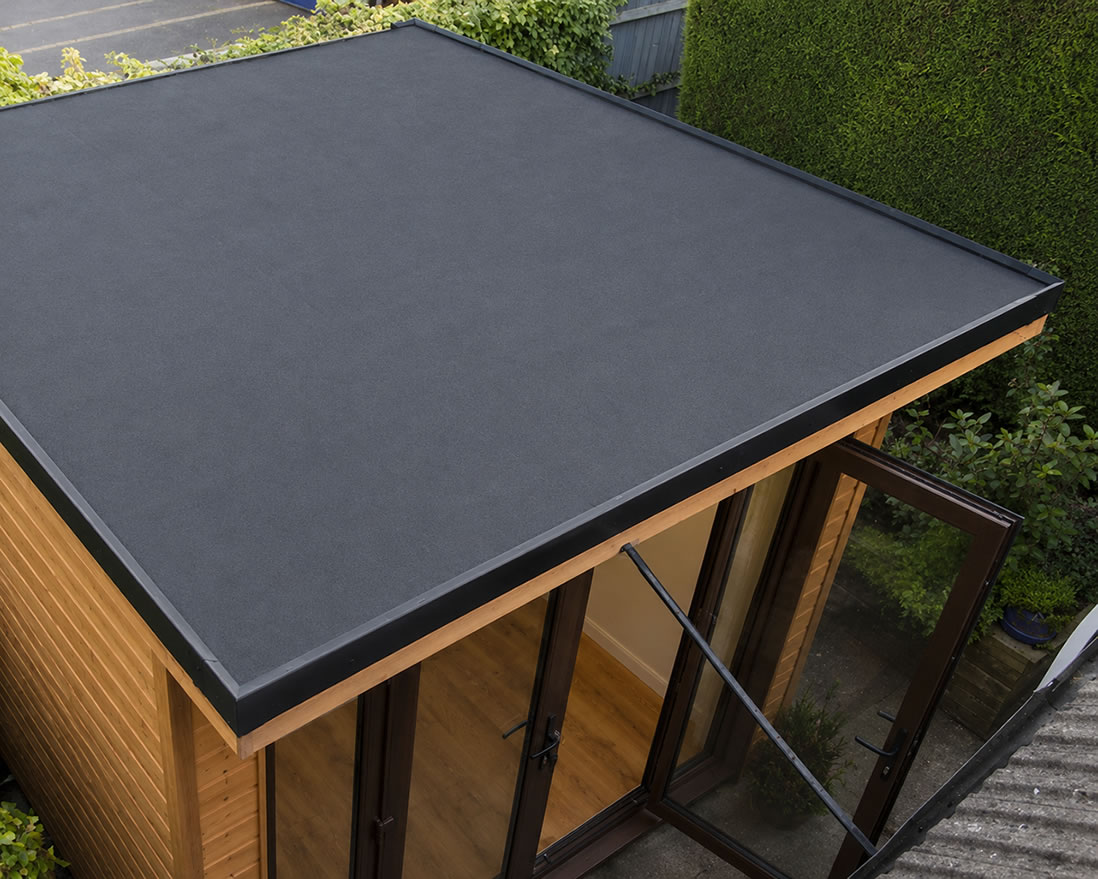
For that reason, many homeowners now consider EPDM rubber roofing for garden sheds. EPDM creates a flexible waterproof membrane that can often cover a small shed roof in a single sheet. As a result, the main roof surface may have no joins at all.
Complete shed roof kits are widely available in the UK. They usually contain a pre-cut membrane, adhesive and the accessories needed to finish the roof edges. Therefore, EPDM can suit both professional replacement work and competent DIY installation.
Nevertheless, successful installation still depends on a firm roof deck, suitable roof falls and careful detailing around edges and corners. This guide explains how EPDM shed roofing works, how much it costs and what fitting it involves.
What is EPDM rubber roofing?
EPDM stands for ethylene propylene diene monomer. Manufacturers produce this synthetic rubber membrane for long-term outdoor exposure.
Roofing-grade EPDM remains flexible in both hot and cold conditions. Consequently, it can accommodate normal movement in timber garden buildings without cracking as easily as some rigid roof coverings.
Homeowners commonly use EPDM on:
- garden sheds
- workshops
- summer houses
- garden offices
- log stores
- bike stores
- garages
- small flat roofs
- pent-roof outbuildings
- some low-pitched apex roofs
Suppliers usually sell the membrane by size or as part of a complete roof kit.
Is EPDM suitable for a garden shed?
Yes. EPDM suits many garden sheds, especially where the roof has a simple shape and a smooth timber deck.
It works particularly well on:
- flat shed roofs
- pent roofs
- shallow-pitched roofs
- single-slope garden buildings
- summer houses
- garden rooms
- workshops
However, roof shape matters. A single sheet fits a straightforward flat or pent roof more easily than a complicated roof with several ridges, valleys or projections.
Although contractors can use EPDM on an apex shed, they may need to detail the ridge carefully or cover each slope separately.
EPDM shed roofing at a glance
| Feature | EPDM rubber roofing |
|---|---|
| Main material | Synthetic rubber membrane |
| Common installation | Fully adhered to timber deck |
| Typical membrane format | One sheet cut to roof size |
| Open flame required | No |
| Suitable deck | Clean OSB or exterior-grade plywood |
| Appearance | Smooth black or dark grey surface |
| Typical maintenance | Occasional inspection and debris removal |
| DIY suitability | Reasonable for competent homeowners |
| Common alternative | Bitumen shed felt |
Why choose EPDM for a shed roof?
Fewer joints
A supplier can cut EPDM to cover the entire shed roof in one piece. Therefore, the main surface may contain no overlaps or seams.
Joints can become vulnerable points on traditional roll felt. By reducing them, EPDM can simplify the waterproofing arrangement.
However, the roof still needs secure detailing at:
- edges
- corners
- gutters
- wall junctions
- pipes
- rooflights
- ridges on apex sheds
Long potential lifespan
EPDM suppliers commonly state an expected service life of around 40 to 50 years or more when installers fit and maintain the membrane correctly. Eurocell, for example, currently states that EPDM membranes can last over 50 years under suitable conditions.
These figures describe potential service life rather than a guarantee for every shed. Actual performance depends on the roof deck, adhesive, drainage, detailing and exposure.
Flexible material
Timber sheds expand, contract and move slightly as moisture levels and temperatures change.
EPDM remains flexible, so it can accommodate normal movement without becoming brittle quickly. This characteristic makes it useful on lightweight timber structures.
Flame-free installation
Installers usually bond shed EPDM with water-based deck adhesive and contact adhesive around edges and details.
Therefore, standard fitting does not require the open gas flame associated with torch-on roofing felt.
Low maintenance
A correctly fitted EPDM shed roof generally needs little maintenance beyond:
- removing leaves
- keeping gutters clear
- checking edge trims
- inspecting after storms
- preventing branches from rubbing the membrane
- repairing accidental punctures promptly
Suitable for DIY kits
Several UK suppliers sell complete EPDM shed roof kits in standard building sizes. At the time of writing, example kits for small sheds start at roughly £80–£90, although prices depend on dimensions, accessories and delivery.
What are the disadvantages of EPDM shed roofing?
EPDM offers several benefits, but it does not suit every project.
Higher initial cost than basic felt
Basic roll felt usually costs less upfront. Therefore, homeowners replacing the roof of a low-value or temporary shed may prefer the cheaper option.
However, repeated refelting can reduce the long-term saving.
The roof deck must be in good condition
EPDM requires a clean, firm and smooth surface. It should not cover rotten boards, loose planks or wet decking.
In many cases, replacing old felt with EPDM also means renewing the deck with OSB or exterior-grade plywood.
Poor preparation can cause bubbles
Dust, moisture, old bitumen and uneven adhesive can prevent the membrane from bonding correctly.
As a result, the roof may develop:
- bubbles
- wrinkles
- loose edges
- poorly bonded areas
- premature lifting
It can puncture
Branches, sharp tools, screws and careless foot traffic can puncture rubber membrane.
Small punctures are normally repairable with compatible EPDM products. Nevertheless, prevention remains better than repair.
The appearance may not suit every shed
EPDM usually creates a smooth black or dark surface. Some homeowners prefer the textured finish of mineral felt or shingles.
Corners and trims need care
The large sheet may look simple to install, but corners often cause problems. Excess membrane must fold or trim neatly without creating water traps.
EPDM compared with traditional shed felt
| Factor | EPDM rubber | Traditional shed felt |
| Initial price | Higher | Lower |
| Typical format | One large sheet | Several overlapping rolls |
| Main roof seams | Often none | Usually several |
| Flexibility | High | Varies by felt quality |
| Open flame | Not normally required | Not required for nailed shed felt |
| Adhesive | Deck and contact adhesives | Nails, adhesive or both |
| DIY difficulty | Moderate | Low–moderate |
| Expected service life | Often considerably longer | Usually shorter |
| Appearance | Smooth rubber | Mineral or bitumen finish |
| Repair method | Compatible rubber patch | Felt patch or adhesive |
| Deck requirement | Smooth and clean | More tolerant, although sound decking remains important |
Is EPDM better than shed felt?
EPDM often offers better long-term value where:
- the shed is worth protecting
- valuable tools or equipment are stored inside
- the roof deck needs replacing anyway
- the owner wants fewer joints
- the building will remain for many years
- repeated felt failures have occurred
- the shed forms part of a garden office or workshop
Traditional felt may remain suitable where:
- budget matters most
- the shed is small or temporary
- the structure may soon need replacement
- the roof has a conventional apex shape
- the homeowner wants a quick, inexpensive covering
Therefore, the better material depends on the building rather than on one product being universally superior.
What does an EPDM shed roof kit include?
Contents vary between suppliers. However, a typical kit may contain:
- EPDM membrane cut to size
- water-based deck adhesive
- contact adhesive
- edge sealant
- gutter or drip trims
- kerb trims
- trim joiners
- corner pieces
- adhesive roller or application tool
- installation instructions
Some basic kits include only the membrane and adhesive. Others provide a complete trim system.
Before ordering, check whether the kit includes:
- enough membrane overhang
- adhesive for the whole deck
- separate adhesive for edges
- suitable trims
- corner components
- sealant
- delivery
- tools
How much membrane should you order?
Measure the roof rather than the outside walls of the shed.
You will normally need:
- the full roof length
- the full roof width
- enough extra material for edges and overhangs
- allowance for any upstands or gutters
For example, a nominal 8 ft by 6 ft shed may have a roof that extends beyond the walls. Consequently, an 8 ft by 6 ft membrane may be too small.
Many suppliers recommend adding approximately 150 mm to 300 mm on each dimension, depending on the trim system and roof design. Follow the kit supplier’s measurement instructions rather than relying only on the shed’s advertised size.
How much does an EPDM shed roof cost?
The total depends on roof size, deck condition and whether you install it yourself.
Typical DIY kit costs
| Shed size | Broad EPDM kit budget |
| 4 ft × 6 ft shed | £80–£130 |
| 6 ft × 8 ft shed | £100–£180 |
| 8 ft × 10 ft shed | £150–£280 |
| 10 ft × 12 ft shed | £220–£400 |
| Large workshop or summer house | £300–£700+ |
Current examples show small EPDM shed kits from approximately £83, while membrane-only products may start at around £9 per square metre before adhesive and trims. Prices and stock can change.
Possible additional DIY costs
| Additional material | Broad cost |
| OSB or plywood roof deck | £20–£45 per board |
| Replacement timber battens | £20–£100+ |
| Edge trims | £10–£30 per length |
| Extra adhesive | £20–£60 |
| Gutter and downpipe | £40–£150+ |
| Fascia boards | £30–£150+ |
| EPDM repair accessories | £15–£60 |
| Waste disposal | £20–£100+ |
Professional installation costs
| Professional job | Broad UK budgeting range |
| Small shed, membrane only | £300–£600 |
| Typical shed roof replacement | £500–£1,000 |
| Replacement including new deck | £700–£1,500 |
| Large workshop or summer house | £1,000–£2,500+ |
| Complex access or structural repair | £1,500–£3,500+ |
Small roofs can cost more per square metre than large roofs because travel, setup and edge detailing still take time.
What affects the price?
The main cost factors include:
- roof dimensions
- flat, pent or apex shape
- existing covering removal
- rotten decking
- timber repairs
- roof falls
- edge trim type
- gutters
- restricted garden access
- waste removal
- membrane thickness
- brand and guarantee
- professional labour
Does the old shed felt need to come off?
Usually, yes.
Installers generally remove old felt before bonding EPDM because:
- loose felt creates an unstable surface
- old nails can puncture the rubber
- trapped moisture may remain beneath it
- bitumen residue can affect adhesion
- damaged decking may remain hidden
- wrinkles can transfer through the membrane
PermaRoof’s shed installation guidance advises applying EPDM to a clean, dry and dust-free surface after removing the existing roof covering and contamination.
After stripping the felt, inspect the deck before deciding whether it can remain.
What roof deck does EPDM need?
EPDM bonds best to a smooth, stable and dry deck.
Common options include:
- OSB3
- exterior-grade plywood
- suitable timber roof board
- approved insulation board on more advanced systems
Many suppliers recommend OSB or plywood for timber roofs. EPDM commonly bonds to these decks using water-based adhesive across the main surface.
OSB or plywood?
| Deck material | Advantages | Considerations |
| OSB3 | Strong, widely available and cost-effective | Joints must remain level and supported |
| Exterior plywood | Smooth and dimensionally stable | Usually costs more |
| Existing timber boards | May save money | Gaps, movement and unevenness can cause problems |
| Chipboard | Low cost | Generally less suitable for exposure to moisture |
The installer should support board joints correctly and keep screw heads flush.
Does a shed roof need a slope?
Yes. Although EPDM forms a waterproof membrane, water should still drain towards an edge or gutter.
A roof with no fall may hold standing water. Over time, ponding can:
- collect dirt
- encourage algae
- add weight
- expose weak details
- freeze during winter
- make maintenance harder
A pent shed normally has a built-in slope. Meanwhile, a flat-looking roof may need firring strips or tapered construction to create suitable drainage.
Should you add a gutter?
A gutter can direct rain away from the shed walls and base.
This may help protect:
- timber cladding
- doors
- windows
- paving
- stored items
- the shed foundation
A gutter trim can also create a neat transition between the membrane and the rainwater system.
How to install EPDM on a shed roof
The exact method depends on the kit. Therefore, always follow the supplier’s instructions.
A typical installation includes the following stages.
1. Check the weather
Choose a dry day with suitable temperatures.
Avoid installation during:
- rain
- frost
- very strong wind
- extreme heat
- periods when the deck remains damp
Adhesives need suitable conditions to bond and cure.
2. Remove the old roof covering
Take off:
- old felt
- nails
- staples
- adhesive residue
- damaged trims
- loose timber
Work carefully so that sharp fixings do not remain in the deck.
3. Inspect the roof structure
Check:
- rafters
- edge timbers
- fascia boards
- deck boards
- fixings
- roof fall
Replace rotten or weakened timber before continuing.
4. Fit a smooth deck
Install OSB3 or suitable plywood where necessary.
The deck should be:
- dry
- firm
- level
- dust-free
- free from sharp fixings
- fully supported at joints
Leave suitable board-expansion gaps where the board manufacturer requires them.
5. Unfold the EPDM
Lay the membrane over the roof without adhesive.
Allow it to relax so that packaging creases reduce. Installation guides commonly instruct installers to let the membrane rest before bonding.
Position it so that enough material extends beyond every required edge.
6. Fold back part of the membrane
Fold approximately half of the sheet back onto itself without creating sharp creases.
This exposes part of the deck while keeping the membrane aligned.
7. Apply water-based adhesive
Apply adhesive evenly to the main timber deck.
Do not leave:
- thick pools
- dry patches
- lumps
- contaminated areas
Avoid applying water-based deck adhesive to sections that require contact adhesive, such as some edges and vertical faces.
8. Roll the membrane into place
Carefully roll the EPDM back over the adhesive.
Use a soft broom or roller to work from the centre outwards. This pushes out trapped air and helps create an even bond.
Then repeat the process on the other half.
9. Bond the perimeter
Installers commonly use contact adhesive around:
- roof edges
- vertical faces
- corners
- upstands
- gutter details
Contact adhesive normally goes onto both surfaces. Allow it to reach the stage specified by the manufacturer before joining the materials.
10. Form corners
Corners require particular care.
Depending on the kit, you may:
- fold the excess membrane
- form a pig’s-ear corner
- use pre-made corner pieces
- trim and seal according to instructions
Avoid unnecessary cuts because each cut creates another detail that needs waterproofing.
11. Install roof trims
Trims secure and finish the roof edges.
Common types include:
- gutter trims
- drip trims
- kerb trims
- edge bars
- corner joiners
Follow the correct fixing spacing and sealant instructions.
12. Check the roof
Inspect:
- corners
- edges
- wrinkles
- loose areas
- trims
- gutters
- drainage
Keep sharp tools away from the finished membrane.
How long does installation take?
| Work involved | Typical DIY timescale |
| Small shed with sound deck | Half a day to one day |
| Typical shed including felt removal | One day |
| Shed requiring a new deck | One to two days |
| Large workshop or summer house | Two to four days |
| Structural timber repairs | Several days |
A professional may complete a straightforward shed in one day. However, wet weather or rotten timber can extend the project.
Is EPDM suitable for DIY installation?
A competent DIYer may install EPDM successfully on a small, low garden shed.
It may suit DIY where:
- the shed roof is easy to reach
- the structure remains stable
- the roof has a simple shape
- the deck is sound
- no electrical equipment sits on the roof
- the installer can follow technical instructions
- the work does not require complicated seams
Professional fitting may make more sense where:
- the roof is large
- the shed sits beside a boundary
- the deck has extensive decay
- the roof has several levels
- a garden room contains insulation
- the building has rooflights
- the roof connects to another structure
- valuable contents need reliable protection
Common EPDM shed roof installation mistakes
Ordering the membrane too small
Measure the full roof, including overhangs and edge details.
Bonding over old felt
Old felt can loosen, hold moisture and contaminate adhesive.
Installing onto damp boards
Moisture can interfere with bonding and become trapped.
Failing to let the membrane relax
Creases become harder to remove once adhesive touches the sheet.
Using the wrong adhesive
Water-based deck adhesive and contact adhesive serve different areas.
Applying too much adhesive
Heavy pools can prolong drying and create uneven bonding.
Trapping air
Work the membrane from the centre towards the edges.
Cutting corners unnecessarily
Folding often creates fewer vulnerable details than cutting.
Ignoring roof falls
EPDM can withstand water, but the roof should still drain properly.
Leaving sharp screws exposed
Raised fixings can damage the membrane from below.
Walking carelessly on the finished roof
Sharp footwear, tools and debris may puncture the rubber.
Can EPDM go over an apex shed roof?
Yes, although apex roofs require a ridge detail.
Possible approaches include:
- one sheet covering both slopes
- separate sheets joined at the ridge
- a reinforced ridge strip
- mechanical restraint beneath a ridge cap
The correct method depends on roof pitch, membrane size and the manufacturer’s system.
An experienced installer may provide a neater result on a prominent apex shed.
Can EPDM go over tongue-and-groove boards?
It may be possible where the boards remain smooth, stable and dry. However, movement and gaps between individual boards can eventually show through the membrane.
For a more dependable surface, contractors often install OSB or plywood over the existing boards.
Can EPDM be fitted over insulation?
Yes, but only as part of a compatible roof system.
For an unheated garden shed, insulation may not be necessary. In contrast, a garden office or hobby room may need:
- insulation
- vapour control
- ventilation or warm-roof construction
- careful edge details
Do not simply place domestic insulation beneath the deck without considering condensation.
Can EPDM be repaired?
Yes. Small punctures and local damage can often be repaired with:
- EPDM cleaner
- primer
- compatible patch membrane
- repair tape
- lap sealant where specified
Do not use ordinary silicone or random bitumen products unless the EPDM manufacturer confirms compatibility.
How do you maintain an EPDM shed roof?
Remove debris
Clear leaves and twigs before they collect around edges and gutters.
Trim nearby branches
Branches can rub, puncture or drop debris onto the membrane.
Check after storms
Inspect for impact damage and loose trims.
Keep gutters clear
Blocked gutters can cause water to back up at the roof edge.
Avoid unnecessary access
Do not use the roof for storage or as a work platform.
Inspect corners and trims
Edge failure often starts where the membrane meets a trim or fascia.
Repair punctures promptly
Small compatible patches can prevent water reaching the deck.
How long will an EPDM shed roof last?
Many suppliers describe correctly installed EPDM as having an expected lifespan of around 50 years. However, a garden shed roof may last less where:
- the deck moves
- trees damage the surface
- edges lift
- water ponds
- installation quality is poor
- unsuitable adhesive was used
- animals or tools puncture the membrane
Even so, EPDM can offer a much longer service period than lightweight budget shed felt when fitted correctly.
EPDM shed roof brands and suppliers
Homeowners may encounter systems and product names such as:
- Elevate RubberCover, formerly associated with Firestone roofing products
- ClassicBond
- ClassicBond Pro
- FIX-R EPDM
- Hertalan
- Resitrix
- SkyGuard
- PermaRoof shed kits
Common UK suppliers include:
- PermaRoof
- Rubber4Roofs
- Rubber Roofing Direct
- Roofing Superstore
- Roofing Megastore
- SIG Roofing
- specialist local roofing merchants
Do not mix adhesives, primers, tapes and trims from different systems without checking compatibility.
Questions to ask an EPDM shed roofer
- Will you remove all the old felt?
- Is the existing deck suitable?
- What board will you use if replacement is necessary?
- How will the roof drain?
- Which EPDM system will you install?
- What thickness is the membrane?
- Will the roof use one sheet?
- What adhesives will you use?
- Are trims and gutters included?
- How will you form the corners?
- Will you replace rotten timber?
- Does the quote include waste removal?
- What guarantee applies?
- Is VAT included?
Comparing EPDM shed roof quotes
| Quote item | Contractor A | Contractor B | Contractor C |
| Roof dimensions | |||
| Old felt removal | |||
| Existing deck assessment | |||
| New OSB or plywood | |||
| Timber repairs | |||
| EPDM brand | |||
| Membrane thickness | |||
| Adhesives included | |||
| Edge trims | |||
| Gutter trim | |||
| Gutter replacement | |||
| Waste removal | |||
| Guarantee | |||
| VAT included | |||
| Total cost |
Should you replace a damaged shed as well as the roof?
A new roof may not provide good value where the building has:
- rotten wall panels
- a failed floor
- major structural movement
- widespread frame decay
- severe foundation problems
- doors that no longer align
- repeated flooding from ground level
In that case, compare the cost of roof replacement with the cost of a new shed.
However, a solid, well-built shed with only a failed felt covering may benefit greatly from an EPDM upgrade.
Get quotes for an EPDM shed roof
When requesting quotations, provide:
- shed length and width
- flat, pent or apex design
- approximate roof age
- current covering
- visible leaks
- deck condition
- rotten edges
- gutter requirements
- garden access
- photographs from a safe position
Find Me Quotes can help homeowners compare quotations from local shed-roofing contractors for EPDM installation, decking repairs, guttering and complete roof replacement.
Frequently asked questions about EPDM shed roofs
Is EPDM suitable for a wooden garden shed?
Yes. EPDM works well on wooden sheds where the roof has a clean, dry and stable OSB or plywood deck.
Is EPDM better than traditional shed felt?
EPDM usually costs more initially but can provide fewer joints, greater flexibility and a considerably longer expected lifespan. Basic felt may still suit inexpensive or temporary sheds.
How much does an EPDM shed roof kit cost?
Small UK kits often start at roughly £80–£100. Larger kits with trims and adhesives may cost several hundred pounds, depending on roof dimensions and specification.
Can I install an EPDM shed roof myself?
A competent DIYer may fit EPDM to a small, low and simply shaped shed. Careful deck preparation, adhesive application and corner detailing remain essential.
Should old felt be removed before laying EPDM?
Yes, in most cases. Removing the felt exposes damaged decking and provides a cleaner, more reliable bonding surface.
Can EPDM be glued directly onto plywood?
Yes, provided the plywood is suitable, smooth, clean and dry. Installers normally use water-based deck adhesive across the main horizontal surface.
Does an EPDM shed roof need a gutter?
A gutter is not always essential, but it can direct water away from timber walls, doors and the shed base. It also creates a neater drainage detail.
How long does EPDM roofing last on a shed?
Suppliers commonly state a potential service life of around 40 to 50 years or more when the membrane is installed and maintained correctly. Actual lifespan depends on the roof deck, exposure, drainage and workmanship.