A bathroom extractor fan removes humid air before it spreads through the home or settles on cold surfaces. When the fan, duct and controls work together properly, they help clear steam, reduce condensation and make the room feel fresher after a bath or shower.
However, fitting the nearest inexpensive fan into a wall does not guarantee good ventilation. Long duct runs, tight bends, closed grilles and a lack of replacement air can reduce performance. Poor electrical positioning also creates a safety concern in a wet room.
This guide explains how bathroom fan installation works in a typical UK home. It covers fan types, airflow, ducting, controls, noise, condensation, electrical requirements, maintenance and the questions homeowners should ask when comparing installation quotes.
Why Does a Bathroom Need an Extractor Fan?
Bathing and showering release water vapour into the air. Without effective extraction, that moisture can move into bedrooms, landings and loft spaces. It may then condense on windows, ceilings, external walls and other cooler surfaces.
A suitable fan can help to:
- Remove humid air close to where it is produced
- Clear steam more quickly after bathing
- Reduce condensation on mirrors, walls and windows
- Limit moisture spreading into the rest of the home
- Remove stale air and odours
- Support the wider ventilation strategy of the property
An extractor fan does not repair leaks, failed waterproofing, rising damp or penetrating damp. Nor will it solve severe condensation if the home lacks appropriate background ventilation or heating. The installer should consider the complete moisture problem instead of treating every patch of mould as proof that the fan alone needs replacing.
What Do the Building Regulations Say?
Ventilation standards differ across England, Wales, Scotland and Northern Ireland. Therefore, the designer must use the rules that apply to the property and the date of the building work.
For homes in England, Approved Document F provides guidance on meeting the ventilation requirements of the Building Regulations. The edition applying to much existing work in 2026 gives a minimum intermittent extract rate of 15 litres per second for a bathroom. It also states that a windowless room using intermittent extraction should continue running for at least 15 minutes after the room is vacated.
The government has published a 2026 edition of Approved Document F, but it does not take effect for ordinary building work in England until 24 March 2027. Earlier guidance continues to apply under the relevant regulatory and transitional arrangements. Consequently, installers should confirm which edition covers the actual project rather than assuming the newest PDF title automatically applies.
The quoted airflow is the rate the installed system needs to achieve, not merely the free-air number printed on a fan box. Duct resistance, bends, terminals and installation quality can all reduce real performance.
Does Every Bathroom Need a Fan?
A new bathroom normally needs a suitable means of extract ventilation. An openable window can provide useful purge ventilation, but it does not always replace the need for designed extraction. People may keep a window shut during cold weather, at night, or for security and privacy.
When refurbishing an existing bathroom, current guidance generally expects an existing extract fan to remain or receive an appropriate replacement. If a bathroom has never had mechanical extraction, an electrician or ventilation installer can assess what the room and wider home require.
Traditional buildings need particular care. Adding a powerful fan while blocking all background ventilation can produce unintended airflow patterns. Equally, drilling through historic fabric or a listed elevation may require consent. Speak to building control or the conservation officer when the property or project falls outside a straightforward installation.
Main Types of Bathroom Extractor Fan
| Fan type | Best suited to | Main advantage | Main drawback |
|---|---|---|---|
| Axial fan | Short, straight wall ducts | Compact and usually inexpensive | Performance can drop on resistant duct runs |
| Centrifugal fan | Longer or more difficult ducts | Better pressure performance | Often larger and sometimes noisier |
| Mixed-flow fan | Medium or long duct routes | Balances airflow and pressure | Usually costs more than a basic axial model |
| Inline fan | Loft or ceiling duct installations | Motor can sit away from the bathroom | Needs safe access and careful condensate control |
| Continuous extract fan | Homes using a continuous ventilation strategy | Low-rate background extraction with boost | Must be correctly commissioned as part of the system |
| Window fan | Where a wall or ceiling route is impractical | Direct route outdoors | Changes the glazing and can look intrusive |
Axial fans
An axial fan moves air in roughly the same direction as its central shaft. Many familiar wall-mounted bathroom fans use this design. They work well through a short, straight duct to an external grille.
Their weakness is pressure. A long flexible hose, several bends or a restrictive roof terminal can reduce airflow considerably. A fan that performs well through a thin external wall may disappoint when connected to several metres of ducting.
Centrifugal fans
A centrifugal fan changes the direction of airflow inside its casing and can generally overcome more resistance. It may suit longer ducts or routes with unavoidable bends. The housing can be deeper, though, so the installer needs enough wall or ceiling space.
Mixed-flow fans
Mixed-flow models combine aspects of axial and centrifugal designs. They often provide useful airflow against moderate duct resistance without requiring an especially bulky bathroom unit. Product performance still varies, so compare fan curves and sound data rather than relying only on the label.
Inline fans
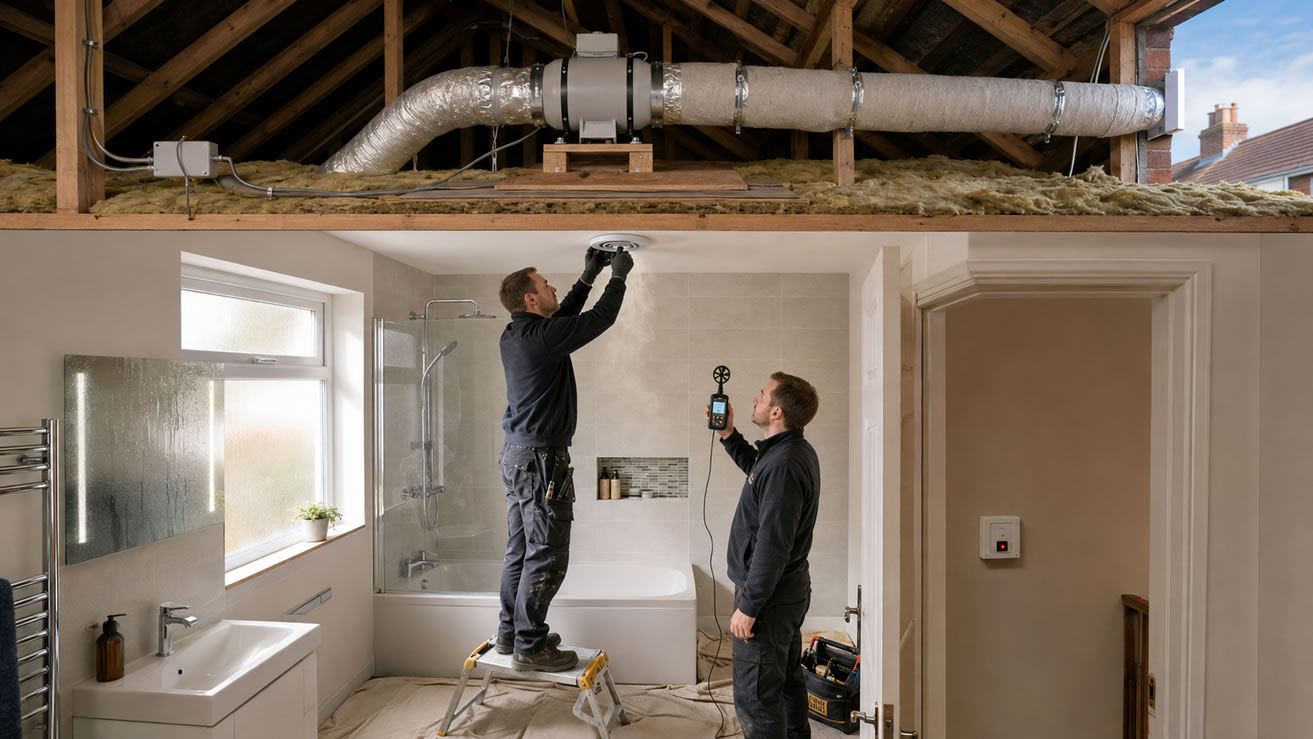
An inline fan sits within the duct rather than directly on the bathroom wall. Installers often place it in an accessible loft and use a ceiling grille above the bathroom. Moving the motor away from the room can reduce perceived noise.
However, the loft installation must remain accessible for maintenance. Ducts in cold spaces also need careful insulation and condensate management. The fan and electrical connections should sit where leaks or condensation will not damage them.
Continuous extract fans
A continuous fan runs at a low background rate and increases to a higher setting when needed. It may form part of decentralised mechanical extract ventilation or a wider whole-house system.
Do not replace a continuous fan with a standard on-and-off model without checking the home’s ventilation design. Doing so may reduce ventilation throughout the property, even if the new fan appears more powerful on boost.
Bathroom Fan Controls Compared
| Control type | How it works | Useful for | Possible issue |
|---|---|---|---|
| Light-switch control | Fan operates with the bathroom light | Simple everyday use | May run unnecessarily during brief daytime visits |
| Overrun timer | Continues after the light or trigger switches off | Clearing moisture after the room is vacated | Needs correct wiring and timer adjustment |
| Pull cord | User starts the fan manually | Independent control | Occupants may forget to use it |
| Humidity sensor | Boosts when relative humidity rises | Automatic response to bathing | Poor settings can cause nuisance operation |
| Occupancy sensor | Detects movement or presence | Hands-free activation | Does not directly measure moisture |
| Continuous low-speed control | Runs continuously and boosts when required | Designed whole-home strategies | Must not be routinely isolated by occupants |
| Smart control | Uses schedules, sensors or connected controls | Fine adjustment and monitoring | More complexity and possible app dependence |
Timer fans
A timer fan keeps running after the light turns off or another trigger ends. The overrun period should reflect the room, usage and applicable guidance. A very short setting may stop before the moisture clears, whereas an excessively long setting can create unnecessary noise and energy use.
Timer models often need a permanent live supply as well as a switched trigger and neutral. This is one reason a replacement is not always a simple like-for-like wiring job.
Humidistat fans
A humidistat starts or boosts the fan when the air reaches a chosen humidity level. It can work well in a family bathroom where users forget manual controls. Nevertheless, outdoor humidity, drying laundry and seasonal conditions can affect operation.
Choose a model with sensible adjustment and manual override. If the threshold is set badly, the fan may run for long periods or fail to react soon enough.
Continuous fans
Continuous extraction can provide steadier moisture control at a low sound level. The installer commissions the background and boost rates rather than leaving the fan on its factory setting. Occupants should receive clear instructions because switching it off at an isolator defeats the ventilation strategy.
Where Should the Fan Be Installed?
The fan or extract grille should remove moisture near its source while encouraging air to travel across the room. In many bathrooms, a high-level position close to the bath or shower works well, provided electrical zoning and product suitability allow it.
If the air enters beneath the door, placing the extract point on the opposite side of the room can create a useful flow path. A grille immediately beside the door may pull replacement air straight out without sweeping humid air away from the shower.
Other considerations include:
- Bathroom electrical zones
- The fan’s ingress-protection rating
- Distance to an external wall or roof terminal
- Joists, pipes and cables hidden in the route
- Access for cleaning and replacement
- External appearance and neighbour positions
- Noise near bedrooms
- Risk of cold draughts through the grille
Never place the unit solely where drilling is easiest. A convenient hole can produce poor air movement, an ugly external grille or a long internal duct once hidden obstacles are discovered.
Wall, Ceiling or Window Installation?
Through an external wall
A wall-mounted fan often provides the shortest and most reliable duct route. The installer core-drills an appropriate opening, fits a sleeve or rigid duct and seals the penetrations. The external grille should resist weather without restricting the airflow excessively.
The duct should normally fall slightly towards the outside so any condensation or rainwater does not run back into the fan or wall. The precise detail depends on the wall construction and manufacturer’s instructions.
Through the ceiling and roof
A ceiling grille can produce a neat finish and allow an inline fan to sit away from the bathroom. The duct may leave through a roof terminal, soffit or suitable wall.
This route requires more design. Warm, humid air passing through a cold loft can condense inside an uninsulated duct. Long flexible hose may sag and collect water. Roof penetrations also need proper weathering by somebody competent to work with the roof covering.
Through a window
A fan can be fitted into suitable glazing when no wall or ceiling route works. A glazing specialist may need to supply a correctly prepared pane. Drilling ordinary toughened glass after manufacture is not a sensible site solution.
Window fans remain visible from inside and outside, while cabling needs a neat and safe route. Check leasehold, listed-building and appearance restrictions before altering the glazing.
Why Ducting Matters as Much as the Fan
The fan creates airflow, but the duct determines how difficult it is to move that air outdoors. Every bend, reduction, grille and length of rough hose adds resistance. As resistance rises, many fans deliver less air.
Good duct design usually includes:
- The shortest practical route to outside
- The duct diameter specified for the fan
- Smooth rigid duct wherever practical
- Sweeping changes of direction rather than tight bends
- Proper mechanical support
- Sealed joints that do not leak humid air
- Insulation through cold spaces
- A suitable external terminal
- Safe access for maintenance
Flexible duct has its place around awkward connections, but installers should pull it taut and keep it short. A crushed concertina hose above the ceiling creates high resistance and traps dust or condensation.
Do not reduce a larger fan spigot into a narrow existing duct simply because the smaller hole already exists. The restriction may prevent the system achieving its required airflow.
Condensation Inside Bathroom Fan Ducting
Warm shower air contains a great deal of moisture. When it touches cold ductwork in a loft, some moisture can turn back into liquid water. The water may collect in low points, drip through the ceiling or run into the fan.
To reduce this risk, the installer can:
- Insulate ducts passing through cold spaces
- Avoid dips and unsupported flexible hose
- Arrange an appropriate fall
- Keep the route short
- Use compatible condensation traps where the design requires them
- Position the fan and electrical parts carefully
- Seal joints so moist air cannot escape into the loft
Brown staining around a ceiling grille or water dripping from a fan does not necessarily mean the bathroom roof is leaking. It may indicate condensate within the duct, although the cause needs proper investigation.
Replacement Air: The Part People Forget
An extractor cannot move much air out of a sealed room unless air can enter to replace it. The usual path may be a correctly sized gap beneath the door, a transfer grille or another part of the property’s ventilation design.
If the fan becomes much louder when the bathroom door closes, restricted replacement air could be one cause. Doors that pull shut or strong whistling through tiny gaps also suggest excessive resistance.
This does not mean leaving a large uncontrolled hole. The installer should provide the air path required by the ventilation strategy while considering sound and privacy. Blocking trickle vents and sealing every internal gap can reduce overall performance.
Electrical Safety in Bathrooms
Water and electricity create an obvious risk. Bathroom electrical installations divide the room into zones around baths and showers, with requirements affecting where equipment can sit and what protection it needs. The correct ingress-protection rating and supply arrangement depend on the exact position and product.
Do not assume every low-voltage-looking fan is suitable directly above a shower. Some use a separate safety extra-low-voltage transformer outside the relevant zones, while others are designed for particular wet locations. The manufacturer’s instructions and current wiring standard both matter.
An electrician should assess:
- Bathroom zone and fan position
- Product voltage and IP rating
- RCD protection
- Earthing and bonding arrangements
- Permanent and switched-live wiring
- Local isolation for maintenance
- Cable routes through walls and lofts
- Existing circuit condition
- Notification or certification requirements
Electrical rules and notification processes vary across the UK. Using a suitably qualified electrician, ideally one registered with an appropriate scheme, provides a clearer route to safe installation and any required certification.
What About Bathrooms With Gas Appliances?
Extract fans can change air pressure within a home. In a property with an open-flued boiler, water heater, fire or other combustion appliance, excessive depressurisation can interfere with the safe removal of combustion gases—even when the appliance sits in another room.
Approved Document F directs installers to consider the interaction with combustion ventilation requirements. If the home contains an open-flued appliance, the bathroom fan should not be chosen or upgraded without a competent safety assessment. This is not an area for guesswork.
How to Choose a Quiet Bathroom Fan
A quiet product matters when the bathroom sits beside a bedroom or when a timer runs after bedtime. However, the fan’s published minimum sound figure does not describe every installation.
Noise can come from:
- The motor and bearings
- Fast-moving air through a small duct
- A restrictive external grille
- Vibrating plasterboard or pipework
- Loose backdraught shutters
- Flexible duct touching ceiling joists
- A fan forced to overcome excessive resistance
- A dirty impeller or filter
Compare sound data at the airflow setting the installer intends to use. A fan may look quiet at its lowest setting but need a higher speed to meet the required extract rate. Good duct design can also reduce airflow noise.
An inline fan can move the motor away from the room, although vibration isolation and duct silencers may still matter. Ask the contractor to explain how the full installation—not just the fan unit—will control sound.
Fan Size and Airflow
Many domestic fans use a nominal 100mm duct, but diameter alone does not prove that a product is suitable. A larger fan or duct can move more air at a lower air velocity, which may help with long routes or noise. Conversely, an oversized fan in a tiny bathroom could create draughts and unnecessary sound if the controls and air path are poor.
The contractor should check:
- Required airflow under the applicable standard
- Bathroom size and moisture load
- Length and diameter of the duct
- Number and type of bends
- External grille or roof terminal resistance
- Background or replacement air
- Noise requirements
- Whether extraction is intermittent or continuous
Ask for the installed airflow to be measured at commissioning. A box specification cannot confirm what the completed system achieves through its real ductwork.
Common Signs That a Bathroom Fan Is Not Working Properly
- Steam remains for a long time after showering
- Condensation spreads into adjoining rooms
- Black mould develops repeatedly around ceilings or windows
- The fan sounds active but little air reaches the outside grille
- Water drips from a ceiling extract point
- The fan rattles, grinds or hums
- A timer stops almost immediately
- The humidistat runs continuously or never activates
- The external flap remains stuck shut
- Flexible ducting has collapsed or filled with water
- Dust heavily coats the grille and impeller
These signs do not all prove the fan needs replacement. A blocked terminal, faulty control, inadequate door undercut or disconnected loft duct can produce similar symptoms. A competent inspection should trace the cause before parts are ordered.
Replacing an Existing Extractor Fan
A like-for-like replacement may appear simple, but first check why the old fan failed. Installing a more powerful unit onto the same crushed duct will not solve poor airflow. Likewise, replacing a noisy motor while leaving a flapping external grille can preserve the irritating sound.
The installer should inspect:
- Existing cable and isolation
- Duct diameter and condition
- Route length and bends
- External terminal
- Signs of condensation or water entry
- Fan position and electrical suitability
- Replacement-air route
- Required control method
- Whole-home ventilation strategy
In a home with continuous mechanical extract or heat-recovery ventilation, use a compatible replacement and recommission the system. Swapping one terminal or fan without balancing the rest may affect several rooms.
Can You Install a Bathroom Fan Yourself?
A confident homeowner may be able to clean a grille or replace a removable filter, but a new fan installation combines electrical work, drilling, duct design and weather sealing. Ceiling routes can also involve working in a loft and forming a roof or wall penetration.
The electrical part may fall within notification or certification rules, depending on the work and UK nation. Furthermore, equipment must suit its bathroom zone. For these reasons, most homeowners should use a competent electrician or ventilation installer for a new fan and obtain any required electrical and commissioning documents.
DIY drilling can also damage hidden cables, pipes, structural timbers or asbestos-containing materials. In homes built or refurbished before 2000, investigate suspect boards, textured coatings or ducts before disturbing them.
Bathroom Fan Installation Process
1. Inspect the bathroom and existing ventilation
The contractor identifies moisture sources, window provision, background ventilation, current fans and the wider home ventilation system. They also check for combustion appliances that could be affected.
2. Calculate the required performance
The installer confirms the airflow and control requirements under the standard applying to the project. Bathroom use, duct resistance and noise expectations inform the fan choice.
3. Choose the extract position and duct route
The design places the extract point near the moisture source and plans the shortest practical route outdoors. It also checks bathroom zones, hidden services, loft conditions and the external terminal position.
4. Select the fan and controls
The contractor chooses an axial, mixed-flow, centrifugal, inline or continuous unit with suitable pressure performance, ingress protection and sound characteristics. Timer, humidity or boost controls are specified at the same time.
5. Install electrical supplies and isolation
A competent electrician provides the correct wiring, protection and safe means of isolation. They follow the manufacturer’s wiring diagram and applicable electrical requirements.
6. Form the opening and fit ductwork
The team drills or forms the wall, ceiling or roof route without damaging structure or hidden services. They fit, seal, support and insulate the duct as required.
7. Fit the fan and external terminal
The installer secures the fan and grille, seals external penetrations against weather and confirms that shutters open freely. All parts requiring maintenance should remain accessible.
8. Test and commission
The completed system is tested for operation, control response and installed airflow. The installer adjusts continuous or boost settings where necessary and checks for excessive noise or vibration.
9. Explain operation and maintenance
The homeowner receives instructions for timers, humidity settings, isolation and cleaning. They should also receive relevant certificates and commissioning information.
What Affects Bathroom Fan Installation Cost?
| Cost factor | Why it matters |
|---|---|
| Existing fan or completely new installation | A new opening, wiring and duct route require more work |
| Wall, ceiling, window or roof exit | Each route needs different labour and materials |
| Duct length and complexity | Long routes need higher-pressure equipment and more installation time |
| Wall construction | Thick masonry and hard finishes take longer to drill |
| Fan type and controls | Inline, quiet, humidistat and continuous models often cost more |
| Electrical condition | New cabling, RCD work or circuit repairs increase scope |
| Loft access | Restricted or unsafe access complicates installation |
| Roof penetration | Requires proper weathering and safe roof access |
| Condensation protection | Insulated duct and traps may be necessary |
| Making good | Tiles, plaster, paint and external finishes may need repair |
| Testing and commissioning | Measured airflow and documentation form part of a complete job |
A cheap fan swap may be poor value if the installer never checks the duct or airflow. Compare the complete scope rather than the price of the appliance alone.
Comparing Bathroom Fan Installation Quotes
Ask each contractor to describe the proposed system clearly. A useful quotation should state:
- Fan make and model
- Design airflow and control method
- Duct type, diameter and approximate route
- Position of the indoor grille and outdoor terminal
- Electrical work and isolation
- IP rating and suitability for the intended location
- Loft or roof work
- Insulation and condensate measures
- Making good inside and outside
- Airflow testing and commissioning
- Waste removal
- Warranty and certification
If one quote proposes a basic axial fan and another includes a mixed-flow inline unit with insulated rigid duct, they are not pricing the same result. Ask both installers to explain why their design suits the route.
Bathroom Fan Maintenance
Dust reduces airflow and can make a fan noisier. Isolate the unit safely, then clean accessible grilles and filters at the interval stated by the manufacturer. Do not pour water or spray cleaning chemicals into the motor.
Check the external grille occasionally for nests, debris, paint or a jammed flap. In a loft, look for sagging duct and signs of condensation, but only enter spaces that are safe and accessible.
Arrange professional attention if the fan becomes unusually noisy, trips electrical protection, smells hot, leaks water or stops responding to its controls. Continuous ventilation systems may also need periodic inspection, filter changes and recommissioning.
Common Bathroom Fan Installation Mistakes
- Choosing a fan from its free-air rating alone
- Running long lengths of loose flexible duct
- Reducing the duct diameter to reuse a small hole
- Adding several tight bends
- Discharging moist air into the loft or soffit void
- Leaving ductwork uninsulated in a cold roof space
- Allowing flexible hose to sag and collect water
- Fitting a restrictive or jammed external grille
- Positioning the extract point beside the replacement-air route
- Ignoring bathroom electrical zones and IP suitability
- Wiring a timer fan without the supplies it needs
- Forgetting a manual override for automatic controls where required
- Installing a fan without checking an open-flued appliance
- Blocking the door undercut or background vents
- Failing to measure airflow after installation
Is a New Bathroom Extractor Fan Worth Installing?
A correctly designed fan is a relatively small component that protects a much larger part of the home. It can make a noticeable difference to steam, condensation and stale air, particularly in windowless bathrooms and busy family homes.
The fan itself is only one part of the installation, though. Ductwork, replacement air, electrical safety, controls and commissioning decide whether it works in practice. A modest fan on a short, smooth route may outperform a powerful model connected to crushed hose.
Start by identifying the moisture problem and checking the existing ventilation. Then compare designs from suitable electricians or ventilation contractors, not just product prices. The best installation should quietly remove humid air, remain easy to clean and discharge safely outdoors for years to come.
Frequently Asked Questions
Does a bathroom need an extractor fan if it has a window?
A window provides useful purge ventilation, but a new bathroom will normally still need a suitable extract strategy under the rules applying to the project. An installer or building control body can confirm the requirement for the property and UK nation.
What airflow should a bathroom extractor fan provide?
For many projects in England covered by the 2021 edition of Approved Document F, the minimum intermittent extract rate for a bathroom is 15 litres per second. Different standards, continuous systems and later regulatory editions may use other design details, so confirm what applies to the work.
How long should a bathroom fan run after a shower?
The useful running time depends on room size, moisture, airflow and controls. Under the English guidance applying to many projects in 2026, an intermittent fan in a room without an openable window should continue for at least 15 minutes after the room is vacated.
Is a humidistat fan better than a timer fan?
Neither is always better. A humidistat reacts automatically to moisture, while a timer provides a predictable overrun after a trigger. The best control depends on bathroom use, household habits and the wider ventilation strategy.
Can a bathroom fan vent into the loft?
No. Humid air should discharge outdoors through a suitable terminal. Releasing it into the loft can cause condensation, mould and damage to the roof structure or insulation.
Why does water drip from my bathroom extractor fan?
Condensation may be forming inside cold or sagging ductwork and running back towards the grille. Rain entry or a plumbing and roof leak are also possible. The duct route, insulation, fall and external terminal need inspection.
Are inline bathroom fans quieter?
They can sound quieter because the motor sits away from the room, often in a loft. However, duct airflow, vibration, mounting and fan speed still affect noise. Compare the complete installed design.
Can I replace a bathroom extractor fan myself?
Cleaning accessible parts is different from electrical replacement. Bathroom zones, IP ratings, wiring and notification rules make professional installation advisable. Use a suitably qualified electrician or ventilation installer and obtain any required certification.
Why is my new bathroom fan not clearing steam?
Possible causes include undersizing, restricted ducting, a blocked external grille, insufficient replacement air, poor positioning or incorrect controls. Ask the installer to measure the actual extract airflow rather than judging performance by sound alone.
How often should a bathroom fan be cleaned?
Follow the manufacturer’s instructions because intervals vary with the fan and home. Check the grille regularly and clean accessible dust before it builds up enough to restrict airflow. Isolate the electrical supply safely before cleaning.