Good driveway drainage starts with a clear answer to one question: where will the rainwater go? Before asking installers for prices, check the proposed surface, the ground beneath it and the route water will take. A quotation that says only “drainage included” leaves too much unresolved.
This guide helps UK homeowners prepare for a professional site visit and compare the drainage work in written quotes. Planning guidance below concerns England; check the position locally in Wales, Scotland and Northern Ireland. Guidance checked on 29 September 2026.
Check what happens to your driveway after rain
If you already have a driveway, photograph it after ordinary rainfall from a safe position. Note where water collects, whether it moves towards the house or pavement, and whether nearby gutters overflow. Keep a record of how long puddles remain rather than describing the drive simply as “wet”.
These observations help an installer investigate the problem. They do not establish its cause. A low spot, blocked outlet or unsuitable ground may need different work, and adding a new surface can leave the underlying issue unresolved.
- Puddles near the entrance: show the contractor their position and ask how the finished levels would change.
- Water beside walls or the garage: ask for the proposed relationship between paving, door thresholds and the damp-proof course to be explained.
- Water leaving the boundary: identify the direction it takes and ask how the design will manage it within an appropriate drainage arrangement.
- Run-off from another area: tell the contractor if a roof downpipe, path or neighbouring slope contributes water.
For routine seasonal upkeep, see our separate guide to getting your driveway ready for winter. Describe recurring ponding when requesting installation quotes, even if you intend to replace the whole drive.
Which driveway drainage options should you discuss?
There are two broad approaches: let water pass through a suitable paving system, or collect surface water and take it to a properly designed destination. A contractor may combine approaches. Ask them to explain the complete arrangement rather than choosing a finish from appearance alone.
| Option | What to establish | Question for the installer |
|---|---|---|
| Permeable block paving | The paving, joints and supporting layers form a compatible system. | Which product and installation specification will you follow? |
| Gravel driveway | The ground preparation and finished levels are suitable for the site. | How will you assess the underlying ground and contain the gravel? |
| Channel drainage | The channel has a specified collection area and destination. | Where does the outlet go, and what work is included beyond the grate? |
| Soakaway or planted drainage area | There is sufficient space and a suitable design for the ground conditions. | What assessment is needed before you can price this solution? |
Permeable paving needs the right supporting layers
Permeable blocks should be priced as a system. For example, Marshalls explains that its Priora paving uses open-graded aggregate in the sub-base, bedding and joints so water can infiltrate. Its permeable paving FAQs also advise checking with the local authority before work starts.
Ask whether the quoted product is intended for permeable installation and whether the proposed layers match its specification. A product name on its own is insufficient detail for comparing two contractors. Request an explanation of any ground assessment, design work and outlet arrangements included.
A drainage channel is only part of the answer
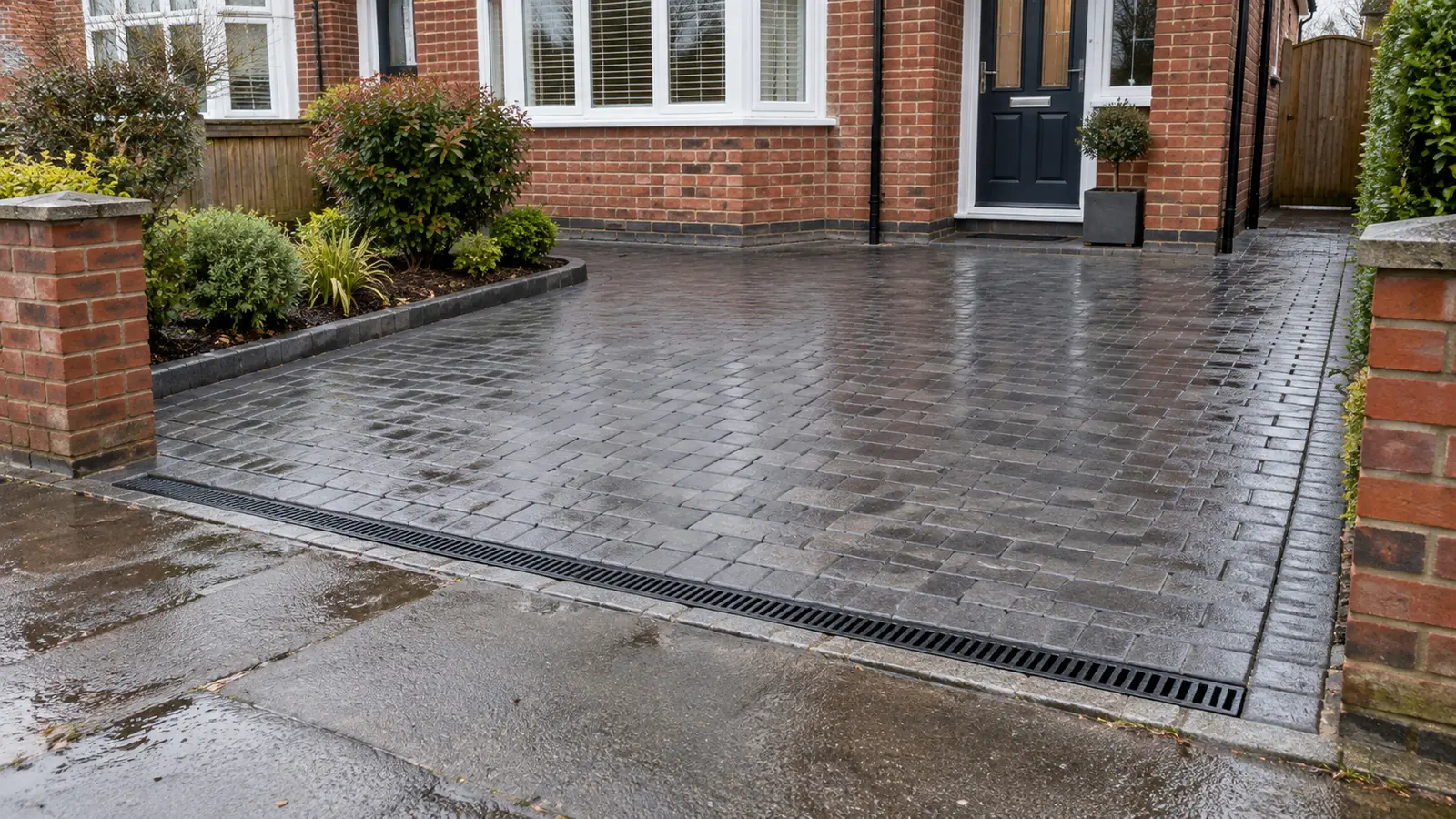
A neat grate across the driveway may look reassuring, but ask where the collected water will discharge. “Fit a channel” should be followed by a description of the outlet and any excavation, pipework or connection work. Ask who will establish whether a proposed connection is permitted.
The government’s guidance on permeable surfacing of front gardens describes permeable construction, rain gardens and soakaways. It explains that the choice depends on factors including soil, slope and existing waterlogging. Have the contractor assess these rather than assuming that a soakaway is suitable everywhere.
Check planning permission before agreeing the layout
In England, a new or replacement front driveway can generally be installed without a planning application if it uses permeable surfacing or directs rainwater to a lawn or border to drain naturally. For an area greater than 5m², traditional impermeable paving generally needs planning permission if water does not run to a permeable area.
The Planning Portal’s front-garden paving guidance explains the conditions. Restrictions may apply to your property, so confirm the position with the local planning authority before commissioning work. Do not apply this England summary automatically to another UK nation.
Creating or widening vehicle access is a separate issue to the surface within your garden. Ask the council about a dropped kerb before including new access in the job. The GOV.UK dropped-kerb service helps homeowners in England and Wales find their council. Record which approvals and associated works sit inside the installer’s quote.
What should a driveway drainage quote include?
When comparing driveway prices, send each contractor the same outline of the job and request a site assessment. The linked service introduces enquiries to independent driveway specialists; availability and each contractor’s quotation will depend on the project.
Ask for the following points in writing:
- Measured scope: the driveway area, any adjoining paths and the areas contributing rainwater.
- Removal and preparation: lifting the existing surface, excavation, waste disposal and treatment of unexpected ground conditions.
- Surface specification: the exact finish, supporting layers and edging, with any optional upgrades separated.
- Drainage design: proposed levels, collection points, destination of water and any assessment still required.
- Associated work: alterations to steps, thresholds, boundaries or existing drainage, where needed.
- Commercial terms: VAT treatment, exclusions, provisional allowances, payment stages, timescale and the process for agreeing changes.
- Handover: maintenance instructions, access for cleaning and any workmanship guarantee, including its exclusions.
Compare the complete scope before choosing the lower price
Imagine two quotes for the same driveway. One includes paving and a channel but leaves the outlet as “to be confirmed”. The other includes a defined outlet arrangement, subject to a ground assessment. The totals are not yet directly comparable: the first still has an unresolved part of the job.
Ask the first contractor to price the missing work or state a clear provisional allowance. Ask both what could change following assessment and how additional costs would be approved. This produces a more useful comparison than dividing the headline total by the driveway area.
How to prepare a driveway drainage brief in five steps
You need a notebook or document, approximate measurements and safely taken photographs. This is preparation for a professional assessment; it does not involve lifting drain covers, digging trial pits or installing drainage.
- Record the existing problem. Note where water collects after rainfall and add photographs taken from a safe position.
- Describe the proposed use. Record the approximate driveway area, vehicles using it and any changes to parking space or access.
- List the surrounding features. Identify visible downpipes, doors, paths, planting beds and existing grates without opening or disturbing them.
- Ask about permissions and assessment. Contact the relevant council where needed and ask installers which site or ground checks they require.
- Request comparable written quotes. Send the same brief to each contractor and ask for surface preparation, drainage destination, exclusions and VAT treatment to be specified.
Driveway drainage FAQs
Does every driveway need a channel drain?
No. A contractor may propose permeable paving or another suitable arrangement instead. Ask them to explain how the complete design deals with the rainwater reaching your driveway.
Can I keep the existing base when replacing my driveway?
Possibly, but have it assessed before accepting a resurfacing quote. Ask the installer to explain whether it suits the proposed finish and drainage design, and what would trigger additional preparation work.
Is a permeable finish enough to settle planning questions?
No. In England it can help meet the front-garden surfacing conditions, but property restrictions and changes to vehicle access still need checking. Confirm the position locally before work begins.
What should I ask if a quote contains a provisional allowance?
Ask what the allowance covers, how the final charge will be calculated, what evidence will support it and whether written approval is required before extra work starts.
What should I receive when the driveway is finished?
Request the agreed product details, drainage layout and outlet information, maintenance instructions, final invoice and any written guarantee. Keep these with the quotation and agreed variations.
Get quotes with the drainage work clearly defined
Before choosing a driveway finish, establish how rainwater will be managed and what investigation the site needs. Then compare written quotations for the same preparation, drainage and finishing work.
You can explore Find Me Quotes’ gravel driveway quote service or tarmac driveway quote service, or send a home improvement quote request. Include your drainage observations so the professionals responding understand the job from the outset.
Featured image: AI-generated illustration of a driveway and drainage channel, not a photograph of a completed Find Me Quotes project.